Is That Really a Kunekune? How to Identify Common Mixes

We learned this lesson the expensive way.
In three recent purchases arranged through Facebook pig groups, we were told we were buying unregistered Kunekune pigs. All three purchases turned out to be substantially different from what we believed we were buying.
The problem is not mixed-breed pigs. Mixed pigs can be excellent animals. We own them, raise them, and may occasionally sell Kunekune crosses ourselves.
The problem is calling a pig an "unregistered Kunekune" when it is actually half Kunekune, a quarter Kunekune, or some combination of Kunekune, Juliana, Pot-Bellied Pig, Idaho Pasture Pig, Spotted swine, and other breeds.
Those are not the same animal.
If a pig is 50% Kunekune and 50% Juliana, there is nothing inherently wrong with it. But the buyer deserves to know that before money changes hands.
This guide covers what we wish we had known before buying pigs online.
First: "Unregistered Kunekune" Does Not Mean "Kunekune Mix"
These terms should not be interchangeable.
An unregistered Kunekune should be a pig whose ancestry is represented as Kunekune but which does not have registry paperwork.
A Kunekune cross has known or suspected ancestry from another breed.
A registered Kunekune is much easier to verify. The American KuneKune Pig Society uses pedigrees and DNA parentage verification. Importantly, there is not a DNA test that can take an unknown pig and tell you "this pig is 82% Kunekune." AKKPS DNA testing verifies a pig against known parents. AKKPS DNA Parentage Testing
That means an undocumented pig may genuinely have Kunekune ancestry, but appearance alone cannot establish its breed or percentage.
This is why a seller saying "they look pure Kunekune to me" is not evidence of purity.
What Does a Kunekune Actually Look Like?
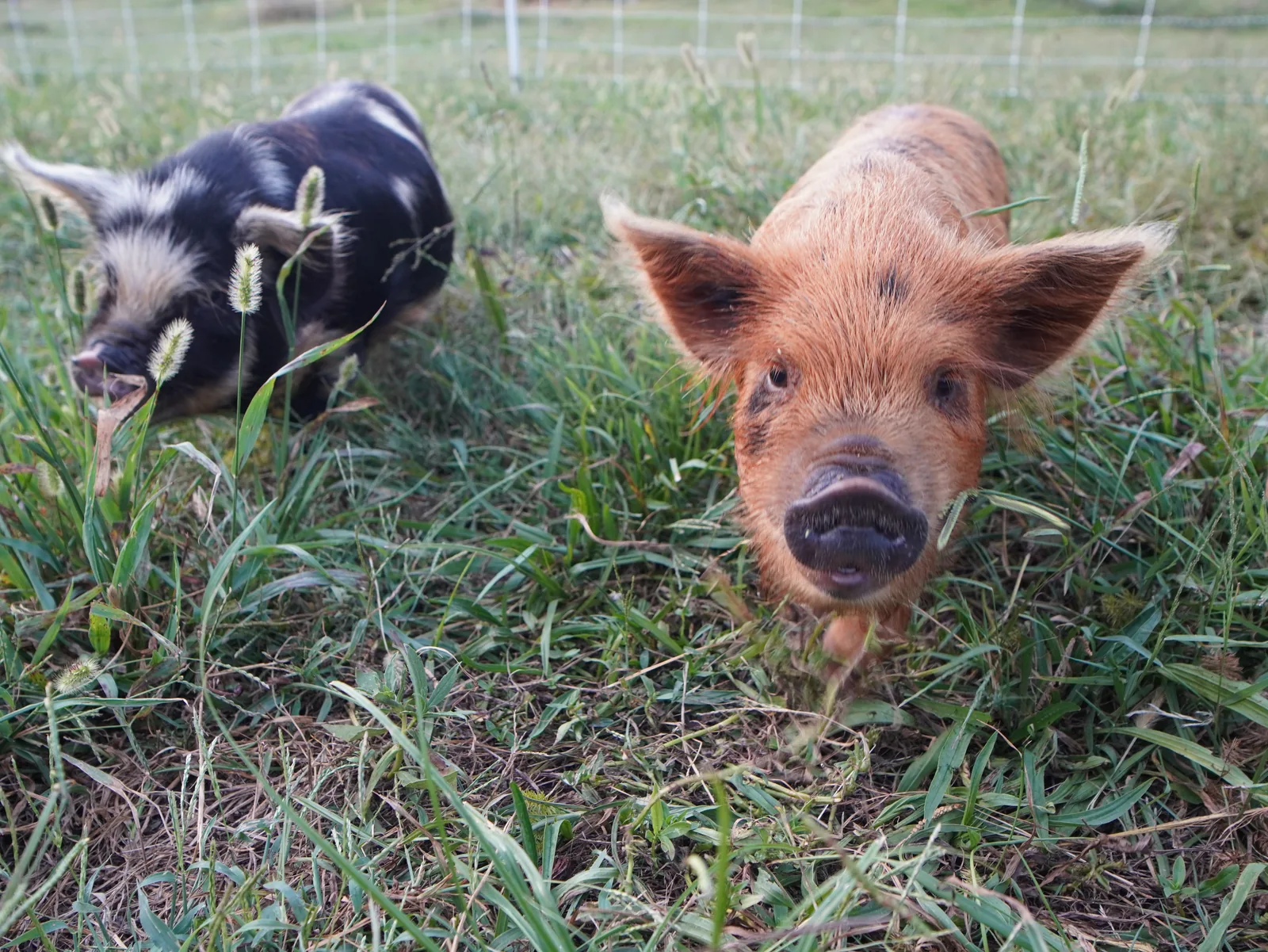
There is variation within the breed, so there is no single Kunekune shape or color.
But there is a breed type.
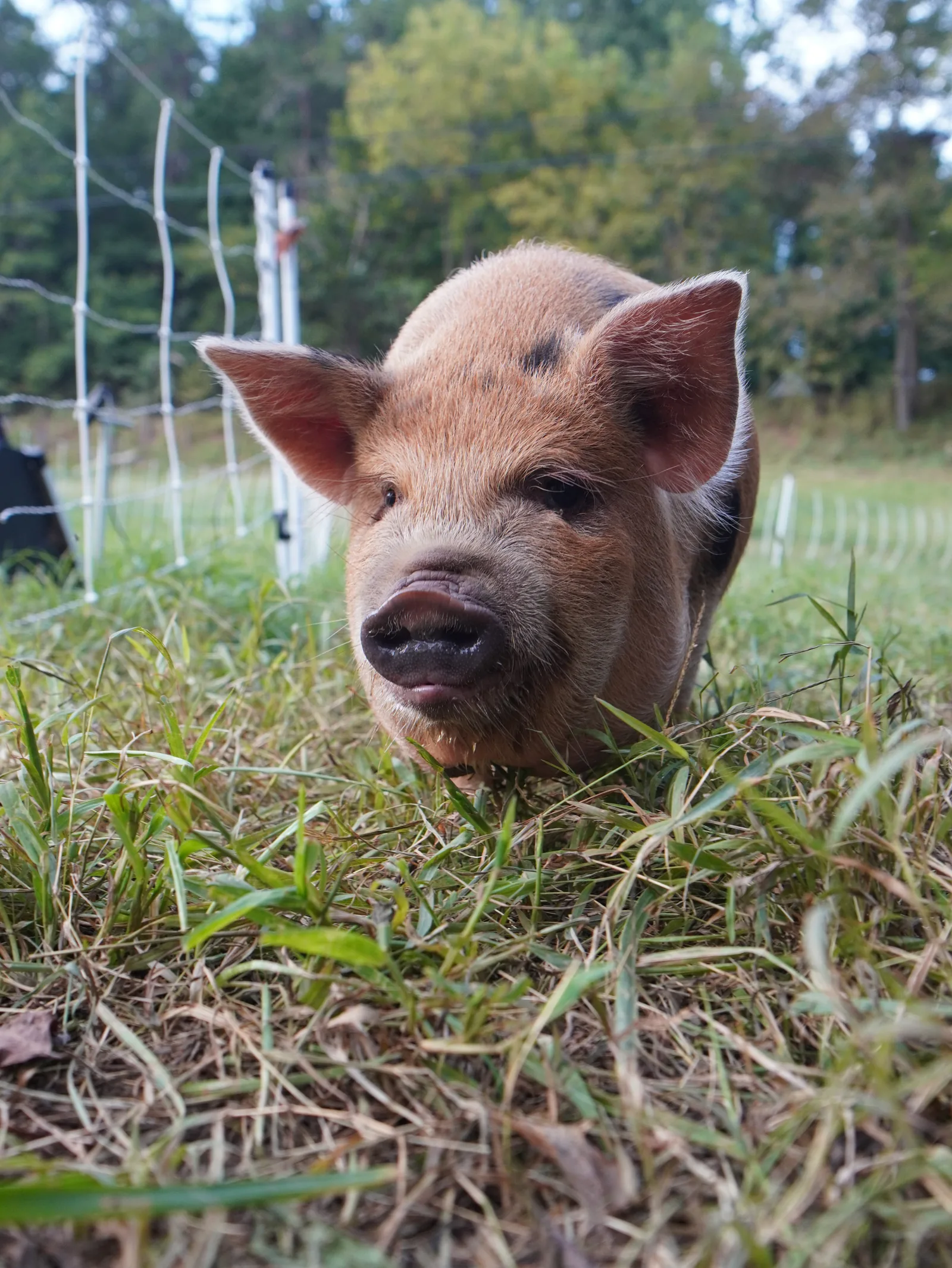
The AKKPS standard describes a Kunekune with a broad, dished face, short-to-medium snout, level shoulders, a strong level or slightly arched back, straight well-set legs, and a friendly, calm, placid temperament. Two well-formed wattles are a desirable breed characteristic. AKKPS Breed Standard
A good Kunekune generally looks substantial without looking tall.
Think:
- Broad head
- Short-to-medium muzzle
- Dish to the face
- Relatively low-set body
- Short-to-medium strong legs
- Deep body
- Strong, fairly level topline
- Rounded hams
- High-set tail
- Heavy seasonal hair coat in many animals
- Calm, confident disposition
- Strong inclination toward grazing
The British Kunekune Pig Society specifically recommends looking for piglets with short legs, a strong body, straight back and essentially "a leg at each corner" rather than a narrow, awkward structure. British Kunekune Society
Kunekunes were selected around grazing ability. Their head and snout structure make cropping grass easier than it is for many conventional hog breeds. British Kunekune Breed Standard
What a Kunekune Should Not Resemble
A typical Kunekune should not look like:
- A tiny commercial hog standing on long legs
- A very narrow, deer-like pig
- A pig with a long, straight pointed nose
- A pig with a dramatically sagging spine
- A classic Pot-Bellied Pig with an extreme hanging belly
- A large-framed commercial hog that happens to have spots
Any one of those traits can appear to some degree in individual animals. Several appearing together should make you investigate the ancestry.
Wattles Are a Clue - Not Proof
The two fleshy tassels hanging beneath the jaw are called wattles, or piri piri.
They are strongly associated with Kunekunes.
They are not a breed detector.
Idaho Pasture Pigs can have two wattles, one wattle, or none at all. IPPs were themselves developed using Kunekune genetics. Idaho Pasture Pig Breed Standard
A crossbred pig can inherit Kunekune wattles too.
So this logic does not work:
It has wattles, therefore it is a Kunekune.
A half-Kunekune pig can have beautiful wattles.
1. Juliana
A proper Juliana has a very different structure from a Kunekune.
The Juliana breed standard calls for a small, lean, athletic pig that is longer than it is tall, with a relatively long, straight snout and small erect ears. A pronounced pot belly or swayback is undesirable. Julianas are also always spotted according to the breed standard. Average height is listed at 15-19 inches. Juliana Breed Standard
Juliana Clues
| Feature | Typical characteristics |
|---|---|
| Head | Longer and straighter nose |
| Legs | Proportionally taller and finer |
| Body | Leaner and lighter-framed |
| Back | Generally straight |
| Belly | Relatively tight rather than hanging |
| Color | Spotted |
| Temperament | Selected for interaction with humans |
| Size | Substantially smaller-framed than most adult Kunekunes |
A young Juliana-Kunekune cross can fool an inexperienced buyer because both breeds can be small, friendly and spotted.
As the pig grows, the difference often becomes more obvious.
Kunekune x Juliana
A 50/50 animal may have:
- Longer legs than a Kunekune
- A narrower chest
- Less body depth
- A longer snout
- Smaller overall mature size
- Spotted coloring
- Wattles if inherited from the Kunekune parent
- Good human sociability
These can make enjoyable homestead pigs.
The tradeoff is that you may lose some of the heavy, low-set Kunekune structure and specialized grazing head shape.
2. Vietnamese Pot-Bellied Pig
Pot-Bellied Pig influence is usually easier to recognize in adults than in piglets.
The American Mini Pig Association describes the traditional Pot-Bellied Pig type as having a short-to-medium snout, small erect ears, large jowls, a pronounced pot belly, swayed back and short legs. American Mini Pig Association
That can superficially resemble a Kunekune because both may be:
- Short-legged
- Round-bodied
- Small compared with commercial hogs
- Shorter-snouted
- Friendly
Look at the entire structure, not one feature.
Pot-Bellied Pig Clues
| Feature | Typical characteristics |
|---|---|
| Head | Often more wrinkled |
| Neck | Short with heavier jowl development |
| Back | Sway is common |
| Belly | Hangs prominently |
| Legs | Short |
| Hair | Frequently thinner than a typical hairy Kunekune |
| Ears | Generally small and erect |
| Temperament | Typically intelligent and placid |
Kunekune x Pot Belly
This cross can become extremely confusing visually.
You might get the Kunekune's hair and wattles combined with:
- More belly
- More sway through the back
- Shorter stature
- Different fat distribution
- Smaller ears
- A more compact head
The resulting animal might be an excellent pet or homestead pig.
It still should not be sold as a pure Kunekune.
3. Idaho Pasture Pig
This is probably one of the easiest breeds to confuse with a Kunekune for good reason:
Kunekune is part of the Idaho Pasture Pig's foundation.
The Idaho Pasture Pig was developed from Kunekune, Duroc and old-type Berkshire genetics. The goal was to retain grazing ability and a good temperament while creating a larger, faster-growing meat animal. Idaho Pasture Pig Registry
A well-bred IPP has a medium-length, wide snout with an upturn at the end. It should have a long, level back, developed shoulders and hams, and a substantially more meat-hog-like body than a Kunekune. IPP Breed Standard
Idaho Pasture Pig Clues
| Feature | Typical characteristics |
|---|---|
| Snout | Medium, broad and upturned |
| Body | Longer and more muscular |
| Back | Long and level |
| Legs | Proportionate rather than extremely short |
| Growth | Considerably faster than a typical Kunekune |
| Adult size | Registry target of roughly 250-350 pounds for sows and 350-450 for boars |
| Temperament | Specifically selected to be friendly and calm |
| Pasture | Excellent grazing ability |
| Wattles | May have two, one or none |
An IPP is not an inferior version of a Kunekune. It is a different breed developed for a different purpose.
Kunekune x Idaho Pasture Pig
For a small farm, this can actually be a very useful cross.
Compared with a pure Kunekune, expect the possibility of:
Pros
- Faster growth
- More length
- Larger hams and loin
- More pork per animal
- Strong grazing characteristics
- Generally manageable temperament
Tradeoffs
- Larger mature animal
- More feed consumed
- Potentially more strength against fences and equipment
- Less classic Kunekune appearance
- More variation between piglets
If someone deliberately breeds this cross and sells it as Kunekune x IPP, there is no problem.
Calling it simply an "unregistered Kunekune" is another matter.
4. American Spotted Swine
This is where the differences can become dramatic.
American Spotted swine, usually called Spots, are full-sized agricultural hogs. They were developed for productive pork production and are known for feed efficiency and fast growth. Their most obvious features are black-and-white spotting and drooping ears. Oklahoma State University - Spotted Swine
Historically, mature Spots were dramatically larger than miniature or Kunekune-type pigs, with mature sows reported around 500-700 pounds and boars considerably heavier. Modern lines vary, but this is fundamentally a conventional-sized hog rather than a miniature breed.
Spotted Clues
| Feature | Typical characteristics |
|---|---|
| Legs | Taller and longer |
| Body | Long and large-framed |
| Muscling | Much more pronounced |
| Snout | Conventional hog structure rather than short grazing muzzle |
| Ears | Generally droop |
| Growth | Rapid |
| Color | Black and white |
| Temperament | Often docile - being a large hog does not mean being aggressive |
The last point matters.
Breed identification should not turn into "Kunekunes are nice and other pigs are mean." Spotted females are specifically noted for gentleness and durability. Oklahoma State University
The major differences are structure, growth, purpose and management.
Kunekune x Spotted
This cross may produce a very capable pasture pork animal, but it can be dramatically different from a pure Kunekune.
Expect the possibility of:
- Longer legs
- Longer body
- Faster growth
- Larger eventual size
- Increased muscling
- More rooting behavior
- A longer snout
- Drooping ears
- Black-and-white spotting
A spotted Kunekune-looking piglet can therefore grow into something much larger than the buyer expected.
Pasture Ability Is One of the Biggest Differences
People often use the phrase "pasture pig" too loosely.
Every pig can eat grass.
Every pig can forage.
That does not make every breed equally adapted to obtaining a meaningful portion of its diet by grazing pasture.
Kunekunes have been selected around grazing conformation. Idaho Pasture Pigs were deliberately developed for the same general production system. Both breed standards emphasize snout structure connected to grazing ability.
Julianas and Pot-Bellied Pigs can forage, but grazing efficiency was not the central agricultural purpose behind their modern breed development.
Commercial breeds such as Spots can absolutely live outdoors and forage, but they were selected much more heavily around growth, feed conversion and pork production.
And none of this means a pig should simply be thrown into a grass field and expected to nutritionally balance itself. Age, season, pasture quality, pregnancy, lactation and growth all affect nutritional requirements.
Rooting Tells You Something - But Not Everything
Kunekunes have a reputation for being easier on pasture than many conventional pigs.
That reputation has merit.
It is not a guarantee that a Kunekune will never root.
Pigs root for multiple reasons. Soil conditions, available forage, minerals, boredom, stocking density and individual behavior all matter.
The useful question is not:
"Does this pig ever root?"
It is:
"Was this animal genetically selected toward grazing rather than aggressive rooting?"
That distinction matters tremendously if you want pigs moving through small paddocks without turning every paddock into a rototilled garden.
Temperament Matters Just as Much as Appearance
Kunekunes are expected to be friendly, calm and placid. Temperament is literally part of the breed standard.
But temperament cannot prove ancestry either.
Julianas are also bred around human interaction. Pot-Bellied Pigs are known for placid temperaments. Idaho Pasture Pigs are selected for friendly, curious behavior. Spotted pigs also have a reputation for docility.
So a friendly pig is a good pig.
It isn't necessarily a Kunekune.
Piglets Are Much Harder to Identify Than Adults
This is where buyers get burned.
A six-week-old cross can look remarkably Kunekune.
Body proportions change. Snouts grow. Legs appear longer relative to the body. Muscling develops. Bellies change. Ears change position. Adult coat may look different.
Even the Idaho Pasture Pig Registry cautions against making some conformation decisions too early because snout structure changes during early development.
Never evaluate a piglet in isolation.
Ask to see:
- The sow.
- The boar.
- Both pigs standing naturally from the side.
- Their faces and snouts.
- Older offspring from previous litters, if available.
- Approximate adult weights of the parents.
- The parents' ages.
A picture of an adorable eight-week-old pig tells you surprisingly little about what will be standing in your pasture two years later.
Five Things That Do Not Prove a Pig Is Kunekune
"It has wattles."
So can an IPP or Kunekune cross.
"It has spots."
Kunekunes can have spots. So can Julianas. So can Spotted hogs.
Color is one of the weakest identification tools available.
"It has short legs."
Pot-Bellied Pigs have short legs too.
"It's really hairy."
Useful clue. Still not proof.
"The breeder told me the parents were Kunekune."
Ask to see them. Then ask where they came from.
The Most Useful Visual Clues
When evaluating a supposed Kunekune, ignore color at first.
Look at the skeleton.
Head
You want a broad head and dished face with a relatively short-to-medium muzzle.
A narrow head with a long straight snout should raise questions.
Back
A strong Kunekune topline should generally be level or slightly arched.
A dramatic sway suggests influence from another type, particularly Pot-Bellied Pig.
Legs
Kunekunes should look relatively low to the ground, but the legs should still be straight, strong and correctly positioned.
Long, fine legs combined with a light body can suggest Juliana influence.
Longer, heavier legs beneath a rapidly growing muscular body may suggest conventional hog ancestry.
Body Depth
Kunekunes should have substance.
A narrow pig with a shallow chest, long legs and light hindquarters may have Kunekune ancestry without having much Kunekune type.
Snout
This may be the single most useful feature.
Shorter, broader and somewhat dished points toward Kunekune type.
Medium and distinctly upturned with a longer meat-type body can suggest IPP.
Long, straight and relatively fine can suggest Juliana or conventional hog influence.
Very short with pronounced pot belly and swayback can suggest Pot-Bellied ancestry.
What Does a 50% Kunekune Actually Look Like?
There is no answer.
That is genetics.
Two 50/50 littermates can look surprisingly different because they did not inherit identical combinations of genes from each parent.
One Kunekune-Juliana piglet might inherit:
- Kunekune wattles
- Kunekune hair
- Juliana legs
- Juliana snout
Its littermate might inherit:
- No wattles
- More Kunekune body depth
- A shorter snout
- Juliana spotting
And once breeders begin crossing crosses, it gets even harder.
A pig could theoretically be:
25% Kunekune
25% Juliana
25% Pot Belly
25% Idaho Pasture Pig
There is no visual calculator that can look at that animal and determine those percentages.
At that point, the only reliable information is the breeding history.
How We Would Buy an Unregistered Kunekune Today
Our standards are different now.
Before money changes hands, we want to know:
- What breed is the sire?
- What breed is the dam?
- Can we see both?
- Where did each parent come from?
- Are either of them registered?
- If not, how does the seller know their ancestry?
- What do the grandparents look like?
- What do mature pigs from the same breeding line look like?
- How old are the parents?
- How large are they?
- How do they behave on pasture?
- How much do they root?
- What does the seller estimate the cross to be?
If the answer to everything is:
"I don't know, but they're definitely pure Kunekune."
Then the honest answer is:
Nobody knows.
Mixed Pigs Aren't the Problem. Misrepresentation Is.
We want to make that distinction very clear because Smoky Mountain Acres is not against crossbreeding.
A Kunekune x Idaho Pasture Pig may make a great pasture pork animal.
A Kunekune x Juliana may make a smaller, friendly farm pig.
A Kunekune x conventional hog may grow faster and produce substantially more pork.
There are legitimate reasons to make each of those crosses.
But breeding goals require knowing what genetics you are working with.
If we sell a pig that we know is a Kunekune cross, we intend to tell the buyer it is a cross.
If we know the parentage, we will tell them the parentage.
If we don't know something, we would rather say "we don't know" than invent an answer.
That is especially important with unregistered animals.
Our Rule After Getting Burned Three Times
We no longer treat these statements as equivalent:
"It looks like a Kunekune."
"I was told its mother was a Kunekune."
"It's an unregistered Kunekune."
"Both parents are documented Kunekunes."
"It is a registered, parentage-verified Kunekune."
Those are five very different levels of certainty.
AKKPS itself makes the same fundamental distinction: there is no DNA breed-percentage test for an unknown pig. Its DNA system verifies descent from known registered parents. AKKPS DNA Parentage Testing
Pictures can tell you whether a pig resembles a breed.
Conformation can tell you whether an animal fits the type of a breed.
Only reliable ancestry tells you where the pig actually came from.
That is the lesson we wish somebody had given us before we started buying "unregistered Kunekunes" from strangers on Facebook.
A mixed pig can be a great pig.
Just sell it as what it is.